Beyond Survival · Sparkling Survivor
My Reality Check: Cording After Breast Cancer
What axillary web syndrome can feel like, what helped me, and how to ask your care team for support.
By Rose Holland
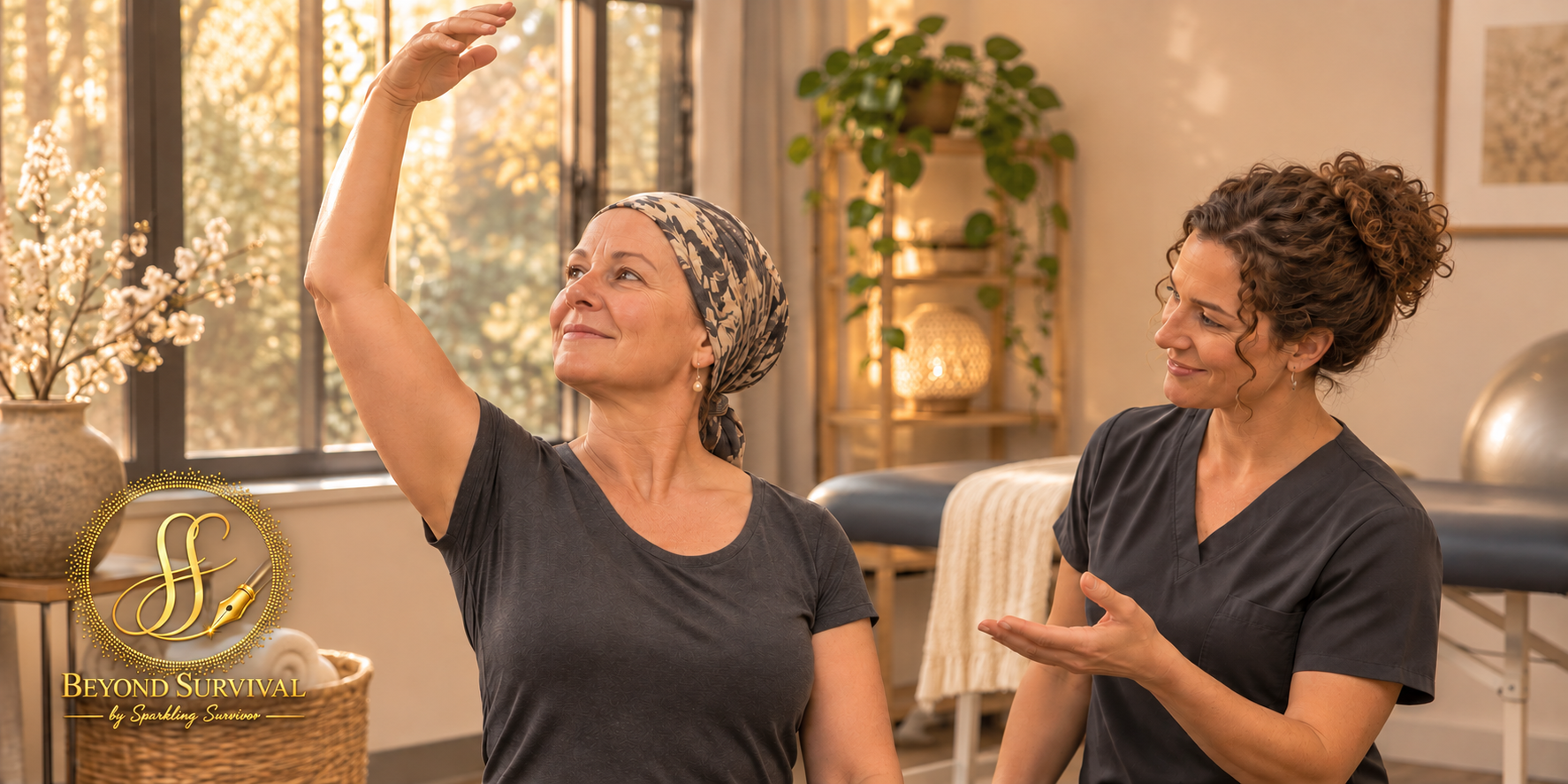
About three months after I finished radiation, I developed axillary web syndrome (AWS), commonly called cording. A physical therapist at my cancer center in La Crosse had told me it could happen. Even with that heads-up, feeling those tight bands for myself caught me off guard.
I’d made it through surgery and radiation with a positive attitude. I hadn’t given myself much time to process the diagnosis. When my surgeon confirmed I had cording, the tears surprised me. It was the first time I really let myself feel what cancer and its treatment had asked of me.
What cording can feel like
Cording can happen after breast cancer surgery, especially when lymph nodes are removed. You might see or feel a thin, tight band under the skin near the armpit. It can extend down the inside of the arm or across the chest. Some people notice a pulling sensation or pain when reaching overhead or straightening the elbow. The exact cause is still unclear, and symptoms can show up weeks or months after surgery.
For me, the tightness has mostly been around my breast and arm, and sometimes around my ribs and shoulder. I can still move my arm fairly well. Most days, it feels more uncomfortable than painful.
What helped me
Knowing what to look for helped me call my surgeon within a week. She examined me and referred me to physical therapy. My therapist worked with me on gentle movement and stretching and showed me what I could do at home. Because I also have early-stage lymphedema, my care plan included a compression sleeve and gauntlet.
I still see an occupational therapist in Eagle River. We’ve worked on soft-tissue techniques, and she showed me how to use therapeutic tape during flare-ups. Overdoing things can bring the tightness back for me. Having a plan I’ve practiced with my therapist makes those days easier to manage.
Recovery varies. A therapist with experience in breast cancer rehabilitation can assess your movement and teach you exercises suited to your symptoms and recovery. If you notice swelling as well as tightness, tell your team so they can assess for lymphedema separately.
What to say to your care team
If you notice a cord, pulling, or new trouble moving your arm after treatment, tell your care team what you feel and which movements bring it on. Ask about a physical or occupational therapist with experience treating cording after breast cancer.
Try saying
“I feel a tight band when I lift my arm. Could this be cording, and can you refer me to someone who treats it?”
I wish more people heard about cording before they felt it for the first time. If it’s happening to you, you deserve someone who will listen, assess what’s going on, and show you what you can do next.
Sources and further reading
About the author
Rose Holland is a Wisconsin native and breast cancer survivor. Her career focused on advocating for military families and creating career development opportunities. A military spouse for more than 30 years, she lived in seven states and Italy before retiring in Wisconsin.
Rose earned a doctorate in education from the University of Wisconsin–Stevens Point, a master’s in theology from St. Norbert College, and a bachelor’s in business administration from the University of Wisconsin–Milwaukee. Breast cancer runs in her family. She was diagnosed with ER/PR-positive, HER2-negative breast cancer in October 2022 and completed treatment in January 2023.
Edited and reviewed by Shelley Schaitel, BSN, RN, OCN
Oncology-certified registered nurse and founder of Sparkling Survivor, LLC
